My Passion for Inclusive Design
How I work: listen first.
The best design decisions are made before anyone opens a design tool. Early in my career I learned that the fastest way to build the wrong thing is to start building. So I don’t. I start by watching and listening. At Ivanti, that meant sitting down for more than 50 interviews with real users at their own conference, then working with my team to find the patterns hidden in what they told us. For Kinware, it meant understanding the emotional reality of divorced parents before designing a single screen. For a complex scheduling system, it meant learning a two-week process well enough to compress it to 30 minutes.
The techniques are the ordinary tools of the trade. Interviews. Affinity mapping. Journey work. Field research. What matters is not the method. It is the discipline of using it before you commit to a direction, so the thing you build is the thing people actually need.
Learning and Mentoring

Back when the world wide web was just getting started, a scruffy architecture student was trying to understand how he might make an impact in this world. I loved working on the main frame, designing the models for people and trees, and doing ok on the buildings, but I was always fascinated with the building blocks more than the final structure. At about the same time, the architectural firm I worked for went from being one of the strongest in the valley to experiencing some difficulty in the early 1990 recession. I started worrying about job stability and growth opportunities. I started looking into more of the computer side of the equation.
I got a job doing tech support for a large dial-up organization, and while I was working there, they asked if I would be interested in designing a page as a backdrop to their new chat interface. It never went anywhere, but that was my first experience understanding how individuals might want to interact with their computers. I knew that people did, but I hadn’t thought about it as a design opportunity until that moment. I eventually moved up in tech support until I found a job for a scheduling company called Primavera Systems. They do project management (they are now a part of Oracle), and while I was doing tech support for their lighter-weight scheduling package, they asked me if I wanted to try designing a wizard. Wizards were all the rage, and this was my first opportunity to break out of support into a position I felt would utilize some of my talents that tech support didn’t.
I did become a full-time designer at Primavera Systems and worked closely with some very talented designers. David Bishop was my first mentor of several, and I was off to the races. I will always be grateful for the time that I spent working there. I eventually became the designer for one of their web products, a product well ahead of its time, and started trying to understand how the web could change peoples’ lives. I took classes from designers like Edward Tufte, Jared Spool, and Jakob Nielson. I got involved with SIG-CHI and helped moderate their mailing list.


― UX LEADER, DESIGN SYSTEMS, ACCESSIBILITY
I design systems and teams that make products work for everyone.
I have over 20 years of experience building and leading UX at scale across healthcare, fintech, and enterprise software.
▶︎ Featured CASE Study
GEP • Enterprise SaaS
Making accessibility the default
A global procurement platform carrying deep accessibility debt, rebuilt into an inclusive design system that ships faster.
From over 6000 Accessibility violations down to fewer than 14 in 18 months
Read the case study →

Design Systems & Visual Data
Multiple Companies, One Experience
Unified two portals across 12M+ accounts and rebuilt the mobile experience from the ground up.

Leadership & Mentoring
Building talented teams
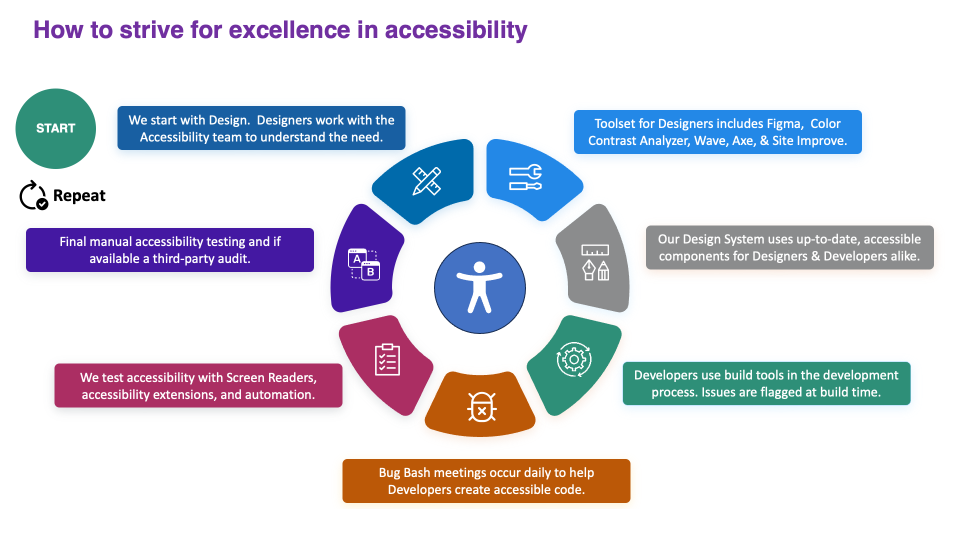
Accessibility
Make Accessibility the Default

AI & UX
Add patterns quickly and easily create a site that looks amazing and help you make a great first impression
Recommendations
FEEDBACK FROm my co-workers
Jason Grotegut
Principal UX Designer, HealthEquity

David will do everything in his power to help improve the user experience of the product, he works tirelessly to try and provide the best experience possible for our clients, members, and internal teammates. As a leader you won’t find a more caring and understanding boss who will help you balance your work with your life needs when things come up sometimes to his own detriment. I have greatly enjoyed working with David who has always treated me as a peer and helped me strive to improve myself as a designer and a person. I would recommend David for any UX leadership positions he would seek out, as his strengths truly lie in helping not just the product but also the people he interacts with.David will do everything in his power to help improve the user experience of the product, he works tirelessly to try and provide the best experience possible for our clients, members, and internal teammates. As a leader you won’t find a more caring and understanding boss who will help you balance your work with your life needs when things come up sometimes to his own detriment. I have greatly enjoyed working with David who has always treated me as a peer and helped me strive to improve myself as a designer and a person. I would recommend David for any UX leadership positions he would seek out, as his strengths truly lie in helping not just the product but also the people he interacts with.
Kathy Wellisch
UX Content and Technical Writer
One of Dave’s defining characteristics is that he’s passionate about helping people. Making a software interface easier to use, absolutely. But also teaching engineers design principles. Promoting a user-first development environment. Championing accessibility. Making sure people feel that their opinions are heard.
I’m not a designer, but I’ve had various projects that needed design feedback and Dave is my critic of choice. He takes enough time to make sure he understands the situation and then provides clear feedback and explains the reasons why I might make different choices.
Dave is a true leader, not because he enforces his opinions, but because he encourages others to learn and share and then come to consensus. He’s a smart guy, but he’s also humble and respectful of others’ viewpoints and expertise. He’s one of the best mentors I know, the kind that makes me consider switching fields so I can learn more from him.
Darren Brabham
Sr. Director Analyst at ETR
Working with Dave Broschinsky at Burton Group, and later Gartner, has been a great experience. In the 2.5 years that I have known him, he has been patient, generous, a fair supervisor, and a heck of a teacher and mentor. I credit Dave Broschinsky with everything I know about usability and design, including best practices, methods, assessments, and how to use cutting edge software tools. These usability and design skills helped me complete my Ph.D. thesis and land a tenure-track job at UNC-Chapel Hill. As a manager, Dave is kind, communicates expectations clearly, and provides constructive feedback on my work that helps me to grow my skills. His knowledge of usability is impressive, and he approaches the theory and practice of user experience design like a scholar; his analytical skills are evident in the papers he has presented and published in scholarly and professional venues. I recommend Dave, without reservation, for his managerial skill, usability and design expertise, mentorship, and all around good attitude.